
Condo Financing Changes All Florida Buyers and Sellers Need to Know
August 26, 2026Fannie Mae retired the Limited Review process for condominium loans effective August 3, 2026. Here is what changed and what it means for South Florida buyers and sellers.
New Condo Financing Rules Are Now in Effect Across Florida
If you own, are buying, or are considering selling a condominium in South Florida, the rules that determine how your buyer gets a loan have officially changed. As of August 3, 2026, Fannie Mae and Freddie Mac retired the fast-track condo review process that many buyers relied on for years.
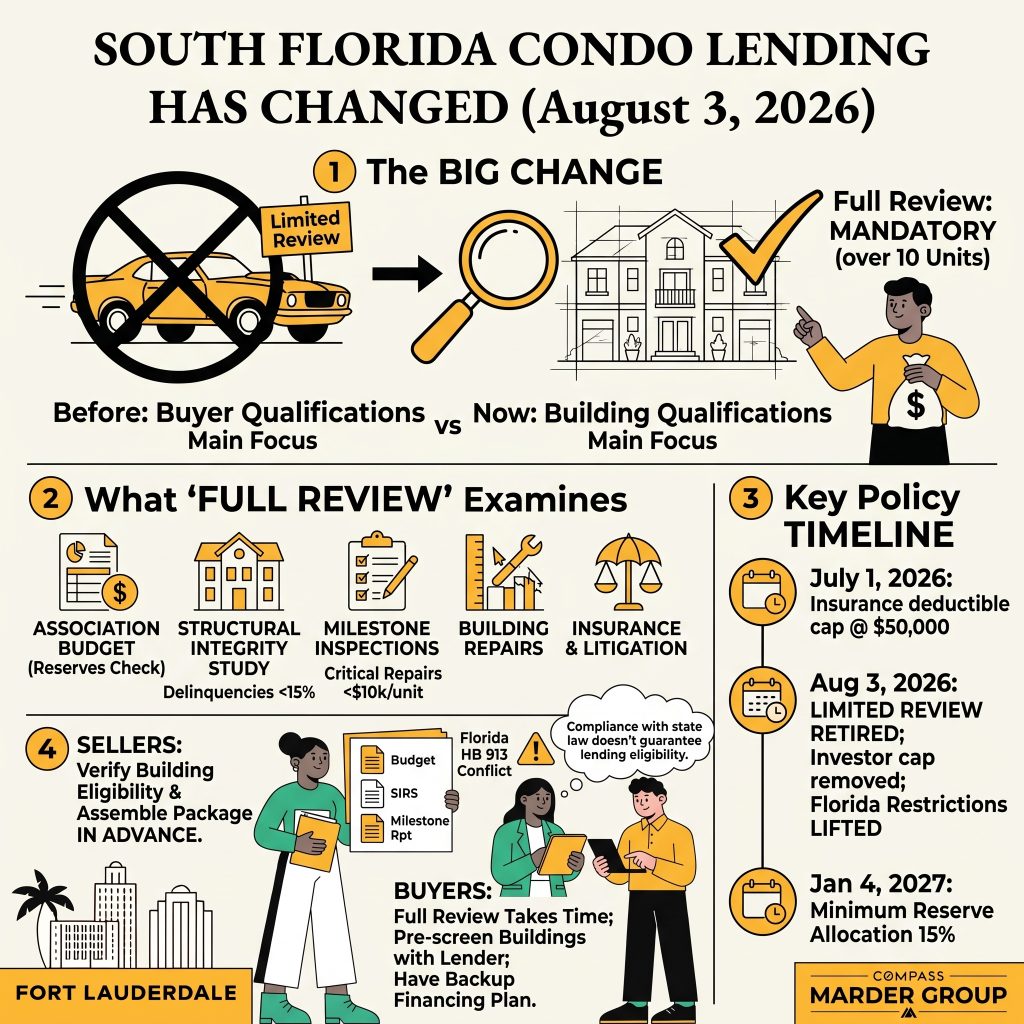
The change is straightforward but significant. Previously, a buyer making a large enough down payment could skip a deep review of the condo association’s finances. That option no longer exists. Any condo project with more than 10 units now requires a Full Review, in which the lender examines the building’s budget, reserves, insurance, delinquencies, and repair obligations.
In other words, the building has to qualify, not just the buyer.
What Limited Review Was and Why It Mattered
For years, Limited Review served as the fast lane for condominium financing. If a buyer put enough money down, the lender verified the basics and moved forward. Nobody pulled apart the association’s reserve study. Nobody asked the board for twelve months of meeting minutes.
As a result, closings moved faster and association boards faced far less paperwork. It also meant units could close in buildings that would not have survived a closer look.
Fannie Mae’s Lender Letter LL-2026-03 and Freddie Mac’s Bulletin 2026-C, both issued March 18, 2026, ended that practice. Established projects that previously qualified for Limited Review must now go through Full Review or, in narrow cases, a Waiver of Project Review.
What Changed and When
| Change | Effective date |
|---|---|
| Limited Review and Streamlined Review retired | August 3, 2026 |
| If reserve budgets carry less than 10%, then the budget must use the highest allocation recommended in the reserve study | August 3, 2026 |
| Master insurance policy per-unit deductible capped at $50,000 | July 1, 2026 |
| Minimum reserve allocation rises from 10% to 15% of the annual budget (however if the | January 4, 2027 |
| 50% investor-occupancy cap retired | August 3, 2026 |
| Florida PERS requirement for new attached projects retired | August 3, 2026 |
| Review waiver expanded to projects of 10 or fewer units | Already in effect |
One detail deserves attention. The deadline runs on the loan application date, not the closing date. An application dated before August 3 may still proceed under the prior rules even if it closes later. An application dated today cannot.
Two Rules Actually Became Easier
Most coverage of this change reads like a warning. However, two provisions moved in the opposite direction, and both benefit South Florida specifically:
The investor concentration cap has been removed
Buildings previously became unfinanceable to investor-buyers when more than half the units were already investor-owned. That rule locked conventional buyers out of many coastal and downtown buildings with significant rental ownership. It has now been retired, and buildings that were non-warrantable for that reason alone can qualify once again.
Florida’s additional restrictions have been lifted
Florida carried stricter condo lending requirements than the rest of the country for years, including a mandatory project review service for new attached developments. Fannie Mae’s letter states that the change “effectively retires the remaining geographic restrictions that apply to the state of Florida.”
Therefore, the accurate takeaway is not simply that condo lending became harder. Lending became harder for underfunded buildings and easier for a specific category of buildings that had been unfairly penalized.
Why These Rules Hit South Florida Hardest
These changes arrive in a market already under pressure. In December 2025, the median price of an existing Broward condo fell 9.27% year over year, from $283,250 to $257,000, according to MIAMI REALTORS. In November 2025, the Miami-Dade condo median dropped below $400,000 for the first time in three years.
Meanwhile, the market has quietly divided in two. Through 2025, sales in condo buildings under 25 years old rose roughly 2%, while sales in buildings over 25 years old fell about 6%. Age has become the dividing line, largely because age is what triggers Florida’s inspection and reserve requirements.
Cash activity tells the same story. Roughly 53% of Broward condo sales now close without any financing at all. Consequently, when a building cannot be financed, its buyer pool narrows to cash purchasers, and those buyers price that limitation into their offers.
The Conflict Most Condo Owners Have Not Heard About
This next point is where the real risk sits, and it is worth reading twice.
Florida law and federal lending rules now contradict each other.
Florida’s HB 913, effective July 1, 2025, allows a condominium association to adopt a “baseline” reserve funding plan, meaning reserves remain above zero without being fully funded. In addition, the law permits boards to pause or reduce reserve contributions for up to two budget years following a milestone inspection.
Fannie Mae’s new rules do the opposite. Baseline funding is no longer acceptable, and the budget must reflect the highest reserve allocation recommended in the reserve study.
Read together, the consequence is uncomfortable. A building can be fully compliant with Florida law and still be unfinanceable. A board can pass its milestone inspection, adopt a lawful budget, follow the statute precisely, and still watch conventional buyers get denied one after another.
Most boards have not yet connected these two rulebooks. Most owners do not know the gap exists. Owners who learn about it early can correct it within a single budget cycle. Those who learn late typically find out from a failed closing.
What Condo Buyers Should Do Now
- Have the building reviewed before writing an offer. Ask your lender to run the project early. Discovering that a building is ineligible after your inspection period has expired is an expensive lesson.
- Request the documents that decide the outcome. These include the milestone inspection report, the Structural Integrity Reserve Study, the current budget with its reserve line, the reserve study itself, twelve months of board minutes, and any pending or approved special assessment.
- Review the reserve percentage carefully. Budgets allocating less than 15% to reserves will face obstacles on applications dated January 4, 2027 or later.
- Allow an additional two to four weeks in your timeline. A Full Review takes longer than what many buyers experienced previously, particularly when an association is slow to produce documents.
- Prepare a backup financing plan. If a building will not qualify conventionally, portfolio and non-QM lenders remain available, generally at higher rates and with larger down payments.
What Condo Sellers Should Do Now
- Determine whether your building is financeable. This is the single most valuable thing you can learn before listing, because it determines your buyer pool and therefore your price.
- Assemble the association package in advance. A completed lender questionnaire, the current budget, the reserve study, the milestone inspection, and the SIRS. Buildings that respond slowly to lender requests lose buyers.
- Disclose assessments clearly. Pending and approved special assessments must be disclosed, and buyers price uncertainty far more harshly than they price a known figure.
- Understand that most problems are fixable. Reserve shortfalls, insurance deductible issues, and unfunded repairs can often be resolved at the board level. That work takes months, which is precisely why it should begin before the sign goes up.
Newer Buildings Now Hold a Measurable Advantage
Under Florida law, milestone inspections are required once a building reaches 30 years of age, or 25 years when located within three miles of the coast. Buildings completed within the last decade have not yet reached that threshold, and they generally operate with newer reserve studies and fewer deferred maintenance obligations.
For that reason, recently built oceanfront condominiums along the Pompano Beach and Fort Lauderdale coastline have become considerably more attractive to financed buyers. Explore current inventory in newer buildings here:
The Bottom Line for South Florida Condo Owners
Buildings that have maintained themselves, funded their reserves, and stayed ahead of their inspections are about to look considerably stronger than those that have not. The gap between a well-run building and a neglected one, which historically appeared slowly through maintenance quality, will now appear immediately in whether a buyer can obtain a loan.
For owners in strong buildings, that represents good news the market has not yet priced in. For owners in buildings with work ahead and low reserves, the pool of buyers who can purchase in your building just reduced significantly.
Frequently Asked Questions
Is Limited Review really eliminated for condos?
Yes. Fannie Mae retired Limited Review and Freddie Mac retired Streamlined Review, mandatory for all conventional loan applications dated on or after August 3, 2026. Both changes were announced March 18, 2026 in Fannie Mae Lender Letter LL-2026-03 and Freddie Mac Bulletin 2026-C.
Can a bigger down payment still avoid a condo full review?
No. Loan approval now depends on whether the condominium project meets eligibility standards, regardless of the borrower’s down payment, credit, or equity. The only meaningful exception applies to very small projects of 10 or fewer units, which may qualify for a Waiver of Project Review.
What does a condo Full Review actually examine?
The association’s annual budget and reserve allocation, the reserve study, master and liability insurance, the percentage of owners delinquent on dues, pending litigation, special assessments, deferred maintenance, and any critical repairs. Unfunded critical repairs exceeding $10,000 per unit, or delinquencies above 15% of units, can make a project ineligible.
How do I find out if my condo building is on Fannie Mae’s ineligible list?
The list is not public. Most owners discover their building’s status only when a buyer’s loan is denied. A lender can check the project’s status through Fannie Mae’s Condo Project Manager, which is why the check should happen before listing rather than during a transaction.
Does the August 3, 2026 condo rule apply to my closing date or my application date?
The application date. A conventional loan application dated before August 3, 2026 may still proceed under the prior rules even if it closes later. Applications dated August 3, 2026 or later must use Full Review.
Did anything get easier for Florida condo buyers in 2026?
Yes. The rule making a building non-warrantable when more than 50% of units were investor-owned has been retired, and Florida’s additional geographic restrictions, including the PERS requirement for new attached projects, have been lifted. Both changes are already in effect.
Find Out Where Your Building Stands
Marder Group at Compass tracks condominium financeability across Broward County and the coastal corridor as part of how every listing is priced and marketed. If you own a condominium and want to understand how these rules affect your building before making any decisions, we are glad to look into it with you.
David Marder, P.A.
Marder Group at Compass
(954) 951-3356
david@davidamarder.com
Learn more about our team and approach: About David Marder | Meet the Team | More Market Updates
This article provides general information about publicly announced lending policy and is not legal, tax, or lending advice. Condominium documents, association rules, and individual lender requirements vary. Consult a qualified Florida condominium attorney and an experienced condominium lender regarding your specific building and transaction. Sources: Fannie Mae Lender Letter LL-2026-03 and Freddie Mac Bulletin 2026-C, both issued March 18, 2026; Florida Statutes 553.899 and 718.112(2)(g); Florida HB 913 (2025); market data from MIAMI REALTORS. Marder Group at Compass. Equal Housing Opportunity.